




How Cursor IDE handles Office files and PDFs, creating security and AI governance blind spots.
Is the title intentionally provocative? Yes it is. But it’s not very far from the truth. As a Coding Assistant, Cursor is great and we love using it. But also as a coding assistant, its main focus is textual files.
Anything that isn’t textual, and it goes haywire.
Cursor Can’t Handle Microsoft Office Files - Or Any Other Binary
Ever tried uploading Office files or PDFs to the chat windows with Cursor, by using the ‘@’ tag or dragging it into the chatbox? Noticed how despite having the file, Cursor wrote a script to extract its content?
We have, and so did our customers…

On the surface, this seems completely reasonable. Cursor knows it can’t process a binary file so it creates scripts to extract the content directly. The real issue happens behind the scenes.
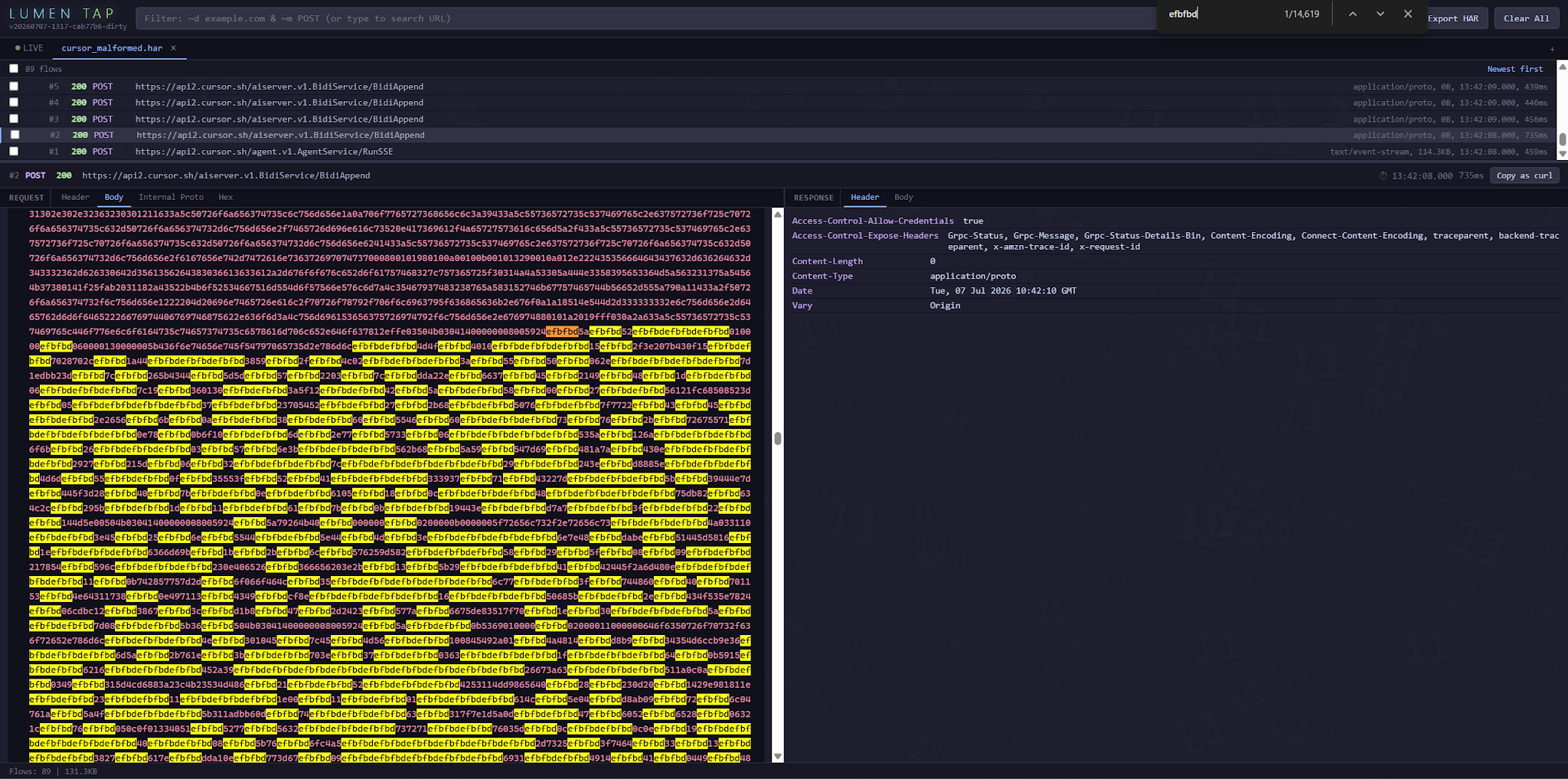
While it seems Cursor just reads the file’s content, it also uploads the file directly to the LLM alongside the prompt. The thing is that this file upload treats the file as if it’s textual, thereby corrupting it in the process, and replacing a lot of its bytes with the Unicode Replacement character EF BF BD.
Using our internal proxy and HTTP inspection tool, we can see that clearly in the traffic:
Doubling and Tripling the Token Waste
Beyond recognizing that Cursor does not support reading binary files, and addresses this by way of corrupting the file, Cursor is wasting a lot of tokens in the process.
It’s not just with the prompt, the read tool has the same mechanism, and sometimes Cursor uses both before even starting to process the file, basically tripling the token usage!
The Real Issue: Complicating AI Governance
Corrupting the file actually leads to the real problem: hindering AI Governance initiatives.
An ideal governance solution needs to inspect all files sent from the application to the LLM. However, since Cursor mangles the file’s content, it’s not easily recoverable, making it not easily governable.
In fact, that’s how we found out about it. At Lumia, we noticed a lot of corrupted files extracted from Cursor’s traffic of our customers, and investigated the cause.
We opened a bug report to Cursor about it. It’s now acknowledged and should be fixed. We’ll track.

